Choosing the right packaging labels for your product is a very important decision. You cannot afford to have any packaging labels and then revert the decision because it will not be a wallet-friendly option to switch labels mid-run. So you need to consider whether to go for shrink sleeves or the traditional label because that’s often the main options businesses have. Both perform the same fundamental role – they talk about the brand, convey essential information and fulfil all necessary regulatory requirements for the product. Where they differ is how it is done. You can discuss with a shrink sleeve manufacturer to help think about your options. A shrink sleeve is a single design that covers the entire container. A standard label is pasted on the container while the remaining part of the container will be exposed.
Check out this blog by Fortune Pack where we explain the intricacies of the two kinds of labels and which would be suitable for yours.
Understanding Shrink Sleeve Labels and Traditional Labels
You can use Shrink Sleeve Labels or Traditional Labels to create your labels. A shrink sleeve is a tube of film that slides over a container and shrinks snugly in place. Heat is applied to the label to ensure it is fit with the curves, tapers and odd shape of the container.
This is where traditional labels are different. They are flat and can be pasted plainly on an even surface using mostly wet glue. They don’t cover the container as such.
Key Differences Between the Two
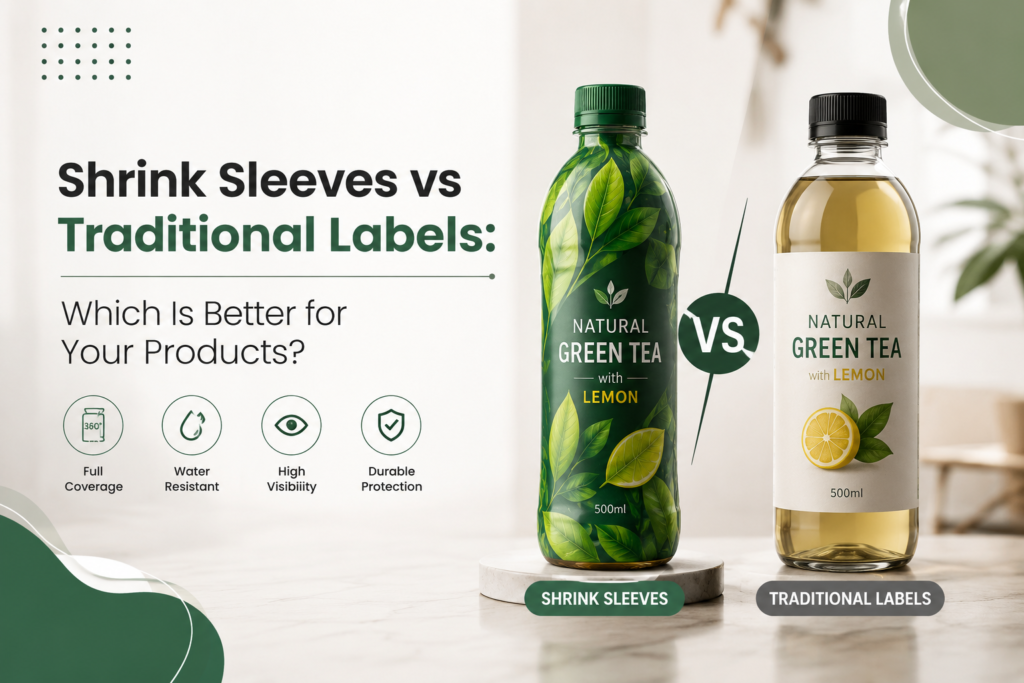
The primary difference between the two lies in coverage. A shrink sleeve can be placed 360 degrees around a bottle or jar giving brands ample space to convey their information. A traditional label just fits the space on a given panel.
The next difference is the application procedure. While shrink sleeves require heat application to shrink the sleeve to its final form, traditional labels are applied using standard label application equipment and adhesive.
This difference has knock-on effects for line speed, equipment requirements, and how a production run is planned out.
Comparing Branding, Design Flexibility, and Shelf Appeal
Shrink sleeves have an edge when you look at branding, design flexibility and shelf appeal. The whole container surface is a canvas for you to brand the product and even tell a story. Because the label covers the entire container, there will be no cap, seam, or awkward curve interrupting the artwork.
Traditional labels are also widely used mainly because they are comfortable for customers and will work well with brands looking to convey a more conservative or minimalistic outlook. They’re simple and perfect for brands looking for a cleaner or more restrained.
Durability, Product Protection, and Tamper-Evident Features
One area that shrink sleeves manufacturers advertise is the tamper resistant feature of the shrink sleeves. This makes it perfect for food, beverage and pharmaceutical products as it also meets regulatory demands as well.
Shrink sleeves are moisture-resistant and perfect for rough handling. This is because the label is wound tightly around the whole container rather than sitting as a separate piece. Traditional labels may not be that durable as they may lift at the edges, wrinkle, or peel over time.
Cost, Production, and Application Considerations
Traditional labels are usually the more affordable when you need only shorter production runs. Shrink sleeves are more expensive than traditional labels mainly because the design needs full container coverage.
Line speed may also be a deciding factor. While standard equipment gives you faster traditional labels, shrink sleeve labels speed will vary based on the heat tunnel configuration and the container type being labeled. Your supplier will be able to shed more light on this.
Which Products Are Best Suited for Each Option
Shrink sleeves are best for products like beverages, personal care items and products that are packaged in a particular shape. They are also a good option when you need tamper resistant features added.
Traditional labels are good for flat containers and when you require smaller quantities. They are also chosen when you need a more modest presence in retail stores.
Factors to Consider Before Choosing the Right Labeling Solution
Here are some factors to consider when choosing a packaging label:
- Container shape because curved, tapered, or irregular containers need shrink sleeves
- Consider production volume because that would affect the cost
- Think about what the product itself demands like moisture resistance or tamper evidence in which case you need shrink sleevs
- If you are looking at smaller batches or simple container shapes, a traditional label might do the job.
Why Choose Fortune Pack as Your Shrink Sleeves Manufacturer?
Fortune Pack has earned a reputation as a reliable shrink sleeves supplier in UAE and has been providing all kinds of packaging labels across food, beverage, personal care and industrial sectors. Our company also offers design support, multiple film options and an impressive production capacity.
If you are moving away from a traditional product line or are creating a new product line from scratch you can consider going for shrink sleeves. This means you will get a finished result that holds up once it’s out in the market.
Conclusion
Consider the shape of the container, the quantity of production and the branding goals. Traditional labels are still a viable option for practical, cost-effective label solutions while shrink sleeves make the container attractive and with provision for full coverage branding.
